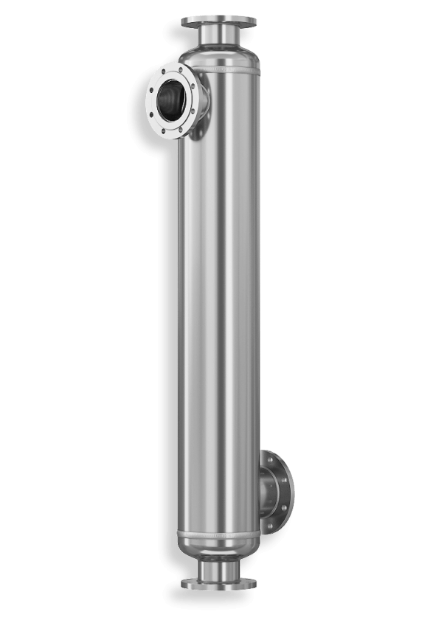


DNA heat exchangers represent the next step in the evolution of tubular heat exchangers. They provide significant benefits in the areas of hydraulics and heat transfer, while maintaining the characteristics and benefits of traditional shell and tube design. DNA achieves significantly higher heat transfer rates compared to the standard solution. The shell side heat exchange surface arrangement allows for more efficient operation in high volume applications (eg flue gas, hot air, low pressure steam). Thanks to its special geometry, the heat transfer coefficient on the tube side achieves up to double values. This advantage can be used for high viscosity media to increase the overall efficiency of the unit. The construction of DNA allows obtaining a smaller, much lighter and material-saving heat exchanger. At the same time, the exchanger maintains all the advantages of the shell & tube heat exchanger, especially its high mechanical resistance.
APPLICATION
• low pressure steam condensers
• industrial and chemical processes
• recovery and regeneration in industrial technologies
• waste heat recovery of diesel and gasoline or gas engines
• water and steam systems, cooling circuits